License the design.
Give IP holders a way to connect a physical part to its authorized CAD source and production record.
Enable digital spare parts.
Keep a physical connection to their origin.
In discussions with automotive-parts manufacturers, we identified an opportunity: help CAD owners earn revenue from licensed spare-part production. But distributing a design creates a difficult question—how do you distinguish an authorized part, made with the right material, from a copy that only looks correct?
Give IP holders a way to connect a physical part to its authorized CAD source and production record.
Link the part to a certified material batch, rather than relying on its shape or an easily separated label.
Trace a suspect part to a printer, shop, and production batch so an investigation can narrow its scope.
Co-inventors: Kurt Dudley & Shawn Mengel
Assignee: Orange Maker LLC
I approached this as a materials-and-process problem: introduce responsive additives, then control their local magnetic orientation or optical response to encode information as a part is made. The design intent extends across printer architectures and material families; each implementation still requires a compatible additive, process, and reader.
A controlled magnetic field turns responsive particles locally. Solidification fixes their orientation. Two-sided Janus particles can present different optical responses depending on which face is exposed.
One proposed implementation uses an infrared-absorbing face and an infrared-reflecting face. A compatible IR reader would distinguish the resulting pattern. Phone-based readout is a development goal, subject to wavelength, camera access, and signal sensitivity.
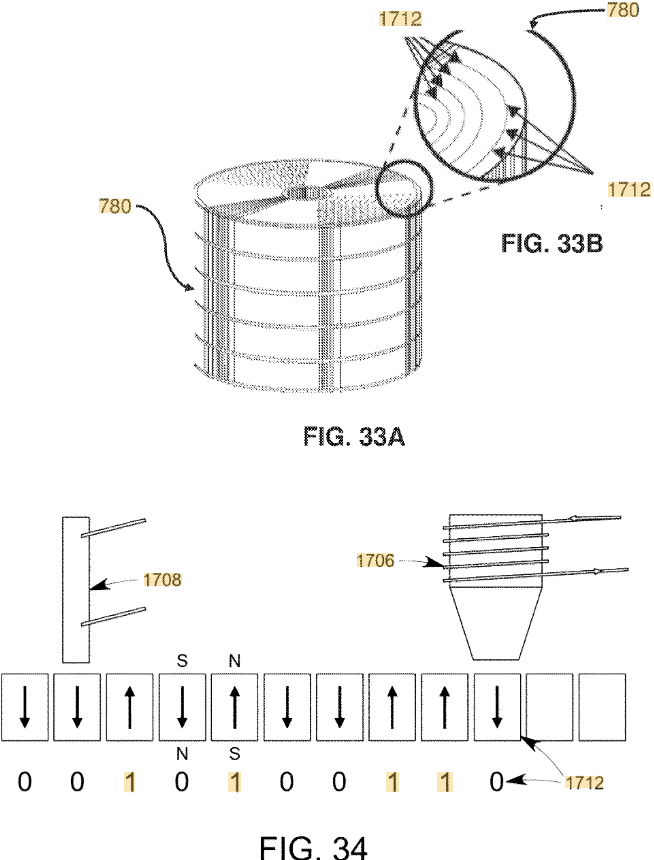
Localized optical stimulation changes the spectral response of selected additives. The resulting pattern forms an optical watermark that a matched illumination-and-sensing system can read.
I think of this as taking the write/read idea of a CD or DVD into a manufactured object: material becomes a carrier of information. Encapsulated additives and distinct spectral signatures offer additional ways to organize that information.
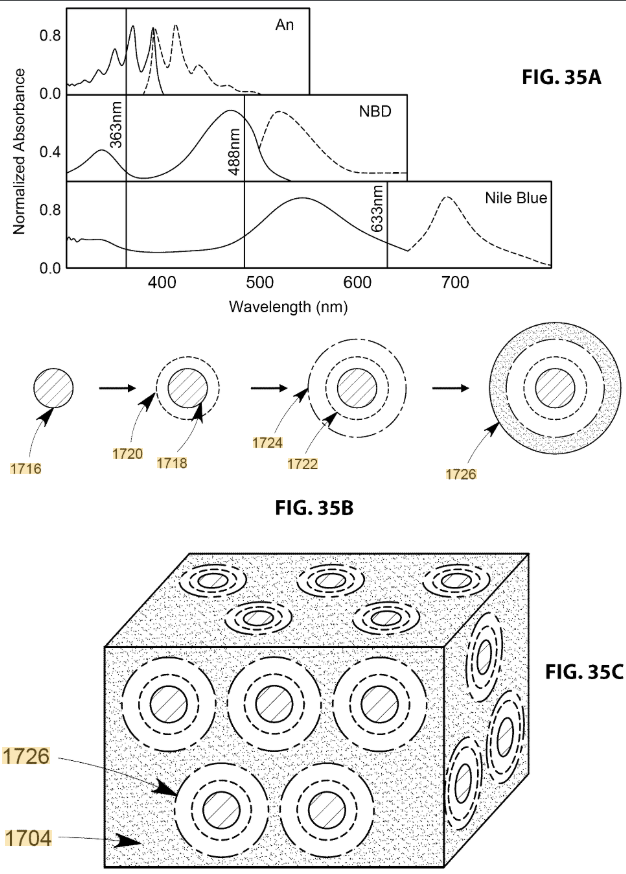
Parts produced together can receive different identifiers. Codes can be placed at selected surfaces and repeated through multiple layers, providing a route to retaining identity when the original surface is worn or damaged.
The encoded payload can carry information directly or serve as a key to a trusted record. Reader resolution, material transparency, and coding density determine how much can be recovered.
For this to be useful, the additive has to support reliable readout while remaining compatible with printing, curing, and the required part properties. Encoding and material qualification need to be developed together.
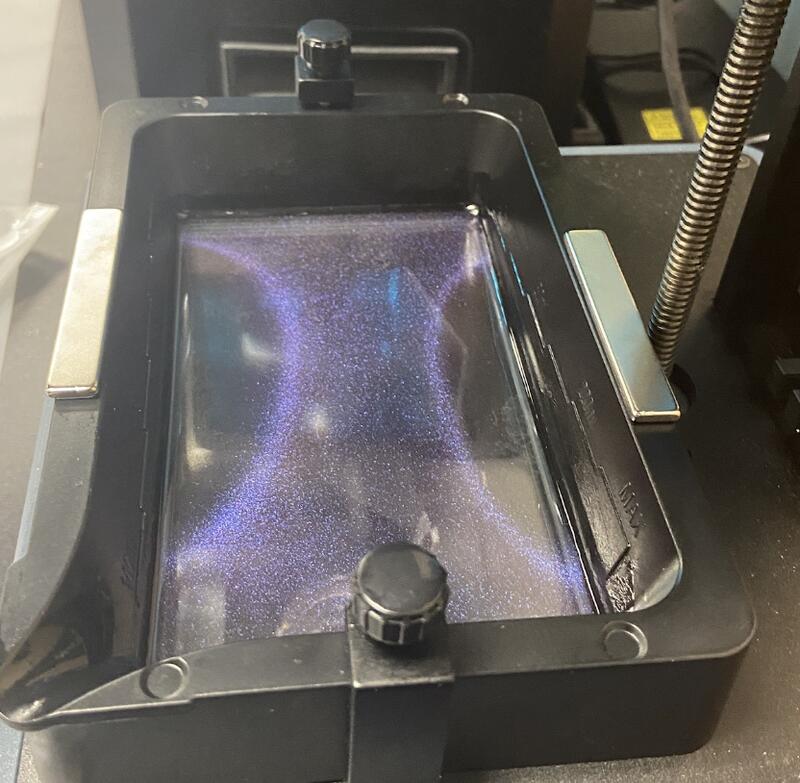
Resin-development image supplied by Kurt.
3D scanning and generative design tools make it easier to reproduce or adapt a shape. My goal is to connect that growing manufacturing freedom to accountable production: licensed designs, identifiable materials, and traceable individual parts.
Repeating data through the volume could allow a surviving fragment to retain useful information. Recovery depends on the remaining code, damage, and reader access.
A readable identifier supports verification against trusted records. It does not by itself prove material performance, prevent copying, or enforce a CAD license.
Combine material formulation, localized writing, sensing, and production software into a traceability workflow suited to the application.
Technical records: Granted patent: description and claims ↗ · Continuation application ↗
Commercial motivation and proposed applications described by Kurt. The technical overview summarizes disclosed approaches; patent scope is defined by the claims. The A1 publication is an application, not a second granted patent.